Home › Project Description › Project Description for Resume
A strong resume project description explains the problem, your personal contribution, the tools or methods used, how the work was checked and what the project produced.
Why projects matter on a fresher resume
When full-time experience is limited, projects can show how you apply knowledge. They are not a substitute for professional experience, but they can provide evidence of technical ability, analysis, planning, teamwork, communication and problem-solving.
Skills used in context
A skills list says you know SQL or Java. A project can show which data, feature, query, API or validation task you handled.
Your personal contribution
The description separates what you completed from what the team, mentor, library or tutorial provided.
Decisions and trade-offs
Tool choice, data cleaning, architecture, testing, error handling or scope decisions show more depth than a list of technologies.
How the result was checked
Testing, validation, comparison, user feedback or review makes the outcome more credible.
Correct project-description structure
| Element | What to write | Example |
|---|---|---|
| Project title | A clear functional name rather than a vague academic label | Sales Performance Dashboard |
| Context label | Academic, personal, internship, freelance, hackathon or team project | Academic team project |
| Dates | Month and year or academic term when relevant | January–March 2026 |
| Tools or methods | Technologies genuinely used and understood | SQL, Excel, Power BI |
| Problem or objective | One sentence explaining what the project addressed | Analysed sample retail data to identify monthly and product-level sales patterns. |
| Contribution bullets | Actions, scope, method, validation and outcome | Cleaned transaction data, wrote aggregation queries and validated dashboard totals against source records. |
| Link | GitHub, portfolio, demo or report only when accessible and safe | github.com/name/sales-dashboard |
The five-part evidence anatomy
Problem
What task, question or user need did the project address?
Contribution
Which modules, analysis, design or testing did you personally handle?
Tools
What technology or method did you use, and for which action?
Validation
How did you test, compare, review or verify the result?
Outcome
What credible output, finding, working feature or learning resulted?
Seven-step writing workflow
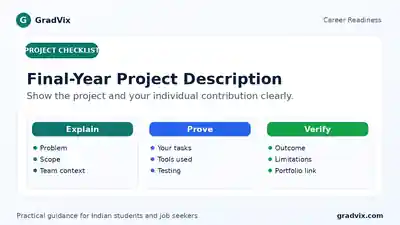
- Choose relevant projects. Select work that supports the target role and that you can explain in detail.
- Write the problem in plain language. Avoid beginning with a long definition of the technology or domain.
- Separate your contribution. Record the modules, analysis, design, documentation or testing you personally handled.
- Name tools in context. Explain what you used each tool for instead of repeating a technology list.
- Add scope and decisions. Mention data size, feature count, workflow, model comparison, architecture or constraints only when accurate.
- Explain validation. State how you tested, reviewed, compared or checked the result.
- Tailor the emphasis. Keep the facts unchanged but prioritise the parts most relevant to the vacancy.
A practical bullet formula
Action + object or problem + tool or method + scope or decision + verified result
| Weak bullet | Improved bullet | Why it is stronger |
|---|---|---|
| Made a dashboard using Power BI. | Built a Power BI dashboard from cleaned sales data to compare monthly revenue, product performance and regional trends. | Explains the data, purpose and analysis. |
| Worked on backend development. | Implemented Spring Boot REST endpoints for student records, including request validation, search and MySQL persistence. | Shows the module, framework and features. |
| Created a machine learning model. | Prepared customer data, compared logistic-regression and tree-based models, and evaluated results using precision, recall and confusion matrices. | Shows process and validation rather than only the model. |
| Responsible for testing. | Designed test cases for login, form validation and CRUD operations, documented defects and rechecked corrected flows before the final demonstration. | Explains the testing scope and actions. |
Role-wise project-description examples
Data Analyst project
Sales Performance Dashboard | Academic Project
SQL, Excel, Power BI
• Cleaned and standardised sample transaction data, including missing categories, duplicate rows and inconsistent dates.
• Wrote SQL queries to calculate monthly revenue, product contribution and regional performance.
• Built an interactive Power BI dashboard and validated summary totals against the cleaned source data.
• Documented assumptions and presented three observations about seasonality and product mix.
Java developer project
Student Record Management API | Personal Project
Java, Spring Boot, MySQL, REST APIs, Git
• Designed REST endpoints for creating, updating, searching and deleting student records.
• Added request validation and structured error responses for incomplete or duplicate data.
• Connected the service to MySQL using a layered controller, service and repository structure.
• Tested common API flows and documented setup and endpoint usage in the repository README.
Python automation project
Monthly Report Consolidation Script | Personal Project
Python, pandas, openpyxl
• Built a Python script to combine similarly structured monthly Excel files into one validated dataset.
• Standardised column names, flagged missing required fields and removed duplicate records based on defined keys.
• Generated a summary workbook with record counts and validation warnings for manual review.
• Tested the script on multiple sample files and documented expected input formats and known limitations.
Digital marketing project
SEO Content Audit | Academic Project
Google Search Console sample data, keyword research, spreadsheets
• Audited a sample website for title, heading, internal-link and content-intent issues.
• Grouped pages by search intent and mapped primary and supporting keywords without duplicating targets.
• Prepared a prioritised action sheet covering content updates, internal links and measurement points.
• Presented the expected effect of each recommendation without claiming unverified traffic results.
MBA or business project
Customer Feedback Analysis | Academic Team Project
Excel, survey analysis, PowerPoint
• Cleaned survey responses and grouped recurring comments into service, product and communication themes.
• Used pivot tables to compare satisfaction patterns by customer segment and purchase frequency.
• Prepared recommendations with supporting evidence and clearly separated findings from assumptions.
• Presented the analysis to faculty and responded to questions about sample limitations.
How to describe a team project
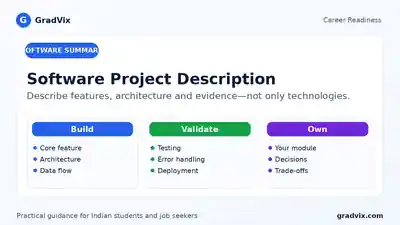
Do not use “built”, “developed” or “created” for the entire result when your role covered only one part. State the team context and your contribution separately.
| Situation | Credible wording | Wording to avoid |
|---|---|---|
| You handled one module | Implemented the authentication and validation module in a four-member team project. | Built the complete application. |
| You analysed one part of the data | Owned data cleaning and dashboard validation for the team’s final analysis. | Performed all data analysis. |
| You used tutorial or starter code | Extended a starter application by adding search, validation and database persistence. | Designed the complete system from scratch. |
| You coordinated documentation | Consolidated module documentation and prepared the final demonstration flow. | Managed the entire project. |
Use metrics only when they are meaningful
Numbers can clarify scope, but invented percentages damage credibility. A useful metric is traceable to the project and relevant to the work.
Credible scope
Number of records, API endpoints, dashboard pages, test cases, survey responses or team members—when accurately counted.
Credible performance
Measured processing time, model metrics, error rate or response time with a clear test method and comparison.
Credible outcome
A completed feature, validated report, working demonstration, accepted submission or documented recommendation.
Unsafe claims
“Improved efficiency by 80%”, “increased revenue” or “achieved 100% accuracy” without reliable evidence and context.
GitHub, portfolio and demo links
A link supports the resume only when it is accessible, organised and safe to share.
Project-description mistakes to avoid
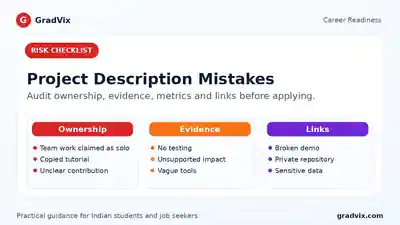
Technology-only bullets
Listing Java, Python or Power BI without showing the work performed.
No personal contribution
The reader cannot separate your work from the team’s result.
Copied tutorial claims
A common project is presented as original without explaining modifications or learning.
Unverified metrics
Impressive percentages appear without a baseline, method or source.
Too much academic theory
The description defines the topic instead of explaining implementation and decisions.
Broken or unsafe links
Repositories are private, incomplete or contain credentials and personal data.
Read project description mistakes freshers should avoid for detailed corrections.
Final project-description checklist
Turn project notes into a clear first draft
Use GradVix to organise your real project facts, then verify the generated description against your implementation, documentation and contribution.
Frequently asked questions
How do I write a project description for a resume?
How many projects should a fresher include?
Can I include academic and personal projects?
Should I add project metrics?
How should I describe a team project?
Can AI write my project description?