Home › Cover Letter › Cover Letter Format
A useful cover letter is a short, role-specific explanation of why your verified education, skills, projects or experience are relevant to one vacancy.
What a cover letter should do
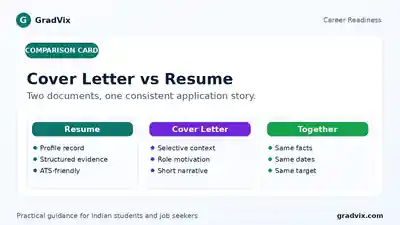
A resume is a structured record of your profile. A cover letter adds selective context. It helps the reader understand which role you are applying for, why the opportunity is relevant and which evidence deserves attention first.
Name the role and direction
The opening should identify the vacancy and your relevant background without vague phrases such as “I am looking for a good opportunity”.
Connect facts to requirements
Use projects, internships, work, coursework or achievements that demonstrate the skills the employer actually needs.
Explain what the resume cannot
A career change, unusual project, relevant motivation or specific contribution may need two or three sentences of explanation.
Support the same application story
The role, dates, skills and examples must agree with your resume, LinkedIn profile, Naukri profile and application form.
Read cover letter vs resume for a detailed comparison of the two documents.
Correct cover letter structure
| Section | What to include | Common mistake |
|---|---|---|
| Contact details | Name, professional email, phone, city and relevant profile link | Adding unnecessary personal data or inconsistent details |
| Date | The date the letter is prepared or submitted | Leaving an old date in a reused letter |
| Greeting | Hiring manager’s name when verified, otherwise “Dear Hiring Team” | Guessing a name or using an overly casual greeting |
| Opening | Role, company and a concise statement of relevant background | Generic enthusiasm with no role named |
| Evidence paragraph 1 | Most relevant skills, education, project, internship or recent work | Listing adjectives instead of evidence |
| Evidence paragraph 2 | A second example, contribution, outcome or reason for the move | Repeating the same lines from the resume |
| Closing | Interest in discussing the role, appreciation and professional sign-off | Demanding a response or asking the employer to “give a chance” |
Seven-step writing workflow
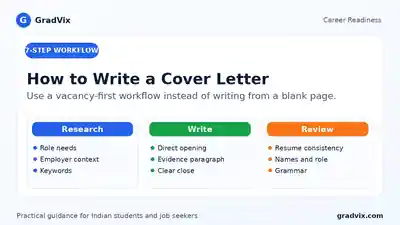
- Confirm the role is suitable. Separate mandatory requirements from preferred ones and do not force a match where core eligibility is missing.
- Choose two evidence points. Select the project, internship, achievement or work example most relevant to the vacancy.
- Write the opening last. Once the evidence is clear, summarise your fit in one direct sentence.
- Explain actions, tools and outcomes. Avoid unsupported adjectives such as hardworking, passionate or excellent.
- Add company context carefully. Refer only to verified information that genuinely explains your interest.
- Check consistency. Match the resume, profile, dates, role titles and application form.
- Read aloud and shorten. Remove repetition, inflated language and sentences that do not help the recruiter assess fit.
Simple cover letter template
[Your Name]
[Phone] | [Professional Email] | [City] | [LinkedIn or Portfolio]

[Date]

Dear [Hiring Manager / Hiring Team],

I am applying for the [Job Title] role at [Company]. I am a [degree, current role or professional background] with experience in [two or three relevant capabilities].

In [project, internship or role], I [action] using [tools or methods]. This involved [scope, contribution or problem] and resulted in [verified outcome or useful learning].

I also [second relevant example]. This experience strengthened my ability to [capability directly connected to the vacancy].

I am interested in this opportunity because [specific, credible reason connected to the role or work]. Thank you for reviewing my application. I would be glad to discuss how my background could support the position.

Sincerely,
[Your Name]
Replace every bracketed section. Do not leave a template phrase that could apply to any company or any role.
Cover letter example for a fresher
Ananya Sharma
Hyderabad | ananya.sharma@email.com | +91 90000 00000 | linkedin.com/in/ananyasharma

24 July 2026

Dear Hiring Team,

I am applying for the entry-level Data Analyst role at [Company]. I recently completed a B.Sc degree and have practical experience using SQL, Excel and Power BI through academic and personal projects.

In a sales-analysis project, I cleaned transaction data, wrote SQL queries to calculate product and monthly performance, and built a Power BI dashboard for trend comparison. I documented the assumptions and checked the dashboard totals against the source data before presenting the result.

I have also used Excel for data validation, pivot tables and reporting exercises. These projects strengthened my ability to organise data, identify inconsistencies and explain findings clearly.

I am interested in contributing to a role where I can support reporting and analysis while developing stronger business and technical judgement. Thank you for considering my application. I would be glad to discuss the position further.

Sincerely,
Ananya Sharma
This example works because it identifies the role, names genuine tools and explains what the candidate actually did. It does not claim professional experience that is not present.
Cover letter example for an experienced professional
Rahul Verma
Pune | rahul.verma@email.com | +91 90000 00000 | linkedin.com/in/rahulverma

24 July 2026

Dear Hiring Manager,

I am applying for the Java Developer role at [Company]. I have three years of backend-development experience using Java, Spring Boot, REST APIs and SQL, with recent work focused on service reliability and reporting workflows.

In my current role, I contributed to REST API development for an internal reporting module. I implemented validation and database changes, supported testing, and investigated production issues with the wider team. The work reduced repeated manual corrections and made the reporting flow easier to maintain.

I am now looking for a role with deeper product ownership and stronger engineering practices. The responsibilities described for this position align with my current backend experience and the areas I am developing further.

Thank you for reviewing my application. I would welcome the opportunity to discuss the role and my relevant work.

Sincerely,
Rahul Verma
Cover letter versus application email
When applying by email, the message body can act as a short cover note. It should usually be more concise than an attached formal letter.
| Format | Recommended use | Typical content |
|---|---|---|
| Formal cover letter attachment | The employer requests a cover letter or the application portal provides a document field | Contact details, date, greeting, evidence paragraphs and closing |
| Email body cover note | You are sending a resume directly to HR or a recruiter | Role, short introduction, one evidence point, attachment note and contact details |
| Application text box | A portal asks why you are suitable or interested | A tailored version that answers the exact prompt without address formatting |
Use the full guide to emailing a resume to HR for subject lines, attachment checks and message examples.
Cover letter mistakes to avoid
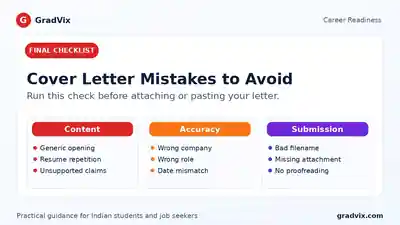
Generic opening
The role and company are missing, so the letter looks reused.
Resume repetition
The letter copies every section instead of selecting the most relevant evidence.
Unsupported claims
Skills, achievements or seniority are overstated and cannot be verified.
Company flattery
Several lines praise the organisation without explaining role fit.
Template errors
The wrong company, role, date or hiring manager remains from another application.
Weak closing
The candidate sounds demanding, apologetic or dependent on the employer giving a chance.
See cover letter mistakes freshers should avoid for additional examples and corrections.
Final cover letter checklist
Create a role-specific first draft
Use GradVix to organise your verified background into a cover letter draft, then edit the result for the exact vacancy and confirm every claim.
Frequently asked questions
What is the correct cover letter format?
Do freshers need a cover letter?
How long should a cover letter be?
Should a cover letter repeat the resume?
Can I use the same cover letter for every job?
Can AI write my cover letter?