A cover letter earns attention by making one application easier to understand—not by sounding impressive or repeating the complete resume.
What to collect before writing
The vacancy brief
Record the exact role, essential skills, responsibilities, location, experience level and any application instructions.
Your evidence bank
List relevant projects, internships, achievements, responsibilities and tools that genuinely match the vacancy.
Employer context
Use the official company or role page to understand the work, product, team or problem area without inventing enthusiasm.
Application consistency
Check the resume, LinkedIn profile and application form so dates, titles, skills and examples remain consistent.
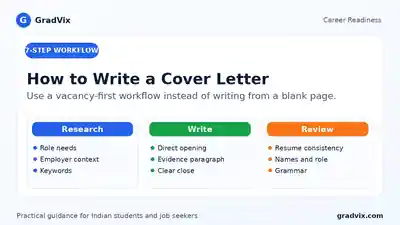
Seven steps to write a stronger cover letter
- Define the job’s main question. Identify what the employer appears to need from this role.
- Select evidence, not adjectives. Choose one or two examples that demonstrate relevant capability.
- Write a direct opening. Name the role, your current background and the main reason your profile is relevant.
- Explain your evidence. Describe your action, tools or method and the verified result or learning.
- Add employer context. Explain why the role or work is relevant to your direction, using specific public information where available.
- Close professionally. Thank the reader and indicate that you are available to discuss the application.
- Run a consistency check. Verify names, attachments, facts, dates, metrics and placeholders before sending.
Match the job description with your evidence
Before drafting, convert the vacancy into a short evidence map. Not every requirement belongs in the cover letter. Prioritise the requirements that are important to the role and supported by your real background.
| Vacancy requirement | Your possible evidence | Proof to mention | Decision |
|---|---|---|---|
| SQL and dashboard reporting | Sales-analysis academic project | Queries written, data cleaned and dashboard created | Use in letter |
| Stakeholder communication | Internship coordination work | Interview scheduling, status tracking and candidate follow-up | Use in letter |
| Three years of professional experience | Coursework and personal projects only | No equivalent full-time employment evidence | Do not claim |
| Knowledge of Git | Used Git during a final-year software project | Repository organisation and version tracking | Supporting detail |
| Leadership | Worked as one member of a team project | No verified leadership responsibility | Avoid inflation |
Write an opening that gives context quickly
| Weak opening | Stronger opening | Reason |
|---|---|---|
| I am a hardworking and passionate person looking for an opportunity. | I am applying for the Junior Data Analyst role. I am a B.Sc graduate with project experience using SQL, Excel and Power BI for cleaning and dashboard reporting. | The stronger version names the role, background and relevant evidence. |
| Please accept my application for any suitable position. | I am applying for the Java Developer role, with current project experience in Core Java, Spring Boot, REST APIs and SQL. | It targets one vacancy instead of asking the employer to find a role. |
A useful opening does not need a dramatic hook. It should help the reader understand the application immediately. For more role-wise patterns, see 60+ cover letter opening lines.
Build the middle around proof
The evidence paragraph should answer three questions:
- What did you work on?
- What was your contribution?
- Why is it relevant to this role?
In my final-year project, I was responsible for selected backend functions, database integration and testing common validation flows. I used Java, Spring Boot and SQL, and documented the parts I completed separately from the work of other team members. This experience is relevant to the role’s focus on API development and reliable data handling.
Generic versus tailored evidence paragraph
Broad claims without proof
I am a hardworking and passionate candidate with excellent technical, analytical and communication skills. I am confident that I can contribute significantly to your organisation and achieve excellent results.
Why it fails: it does not name a project, action, tool, responsibility or verified result. The same paragraph could be sent for almost any vacancy.
Relevant evidence connected to the role
In a sales-analysis project, I cleaned transaction data in Excel, wrote SQL queries to compare monthly and product performance, and built a Power BI dashboard. I checked the dashboard totals against the source data and documented the assumptions used in the analysis.
Why it works: it identifies the work, the candidate’s contribution, the tools used and the evidence relevant to a reporting or data-analysis vacancy.
Add company context without flattery
A company-specific sentence can improve relevance when it is based on something concrete. Refer to the role’s work, product area, customer problem, technology environment or learning opportunity. Avoid empty statements such as “your prestigious company is my dream organisation”.
| Generic | Specific |
|---|---|
| I want to work for your reputed company. | The role interests me because it combines backend development with API and database work, which matches the areas I have been strengthening through projects. |
| I admire your organisation’s success. | I am interested in contributing to reporting and operational analysis in a team that uses data to support day-to-day decisions. |
Use a concise closing
Thank you for reviewing my application. I would welcome the opportunity to discuss the role and explain my relevant projects and experience in more detail.
Do not demand a response, overstate confidence or write several closing paragraphs. A clear, polite next step is enough. Compare more endings in 60+ cover letter closing examples.
Run the recruiter-readability test
- Can the role and your current background be understood from the opening?
- Does the middle provide evidence instead of adjectives?
- Is the evidence directly relevant to the vacancy?
- Can every claim be supported by the resume or interview?
- Could the letter be sent to any company unchanged? If yes, tailor it further.
- Does it fit comfortably on one page?
Start with a structured draft
Generate a role-specific starting point, then verify and rewrite it using your own evidence and natural language.
Use the cover letter format guide for page structure, the role-wise fresher examples for adaptation patterns, and the Cover Letter Samples hub for complete role-wise letters.
Final tailoring and submission checklist
Role and evidence check
Personalisation check
Submission check
Frequently asked questions
What makes a cover letter get recruiter attention?
Should I repeat my resume?
How much company research should I include?
Can freshers write a strong cover letter?
Can AI write my cover letter?
Does a cover letter guarantee an interview?