The most damaging resume mistakes are not secret design violations. They happen when the application cannot capture your information correctly, your evidence does not match the role, or a recruiter cannot quickly understand and trust what you have written.
This guide explains seven resume mistakes to fix before applying in 2026. It connects the ATS side of the application with the broader work of writing a clear, credible and role-specific resume.
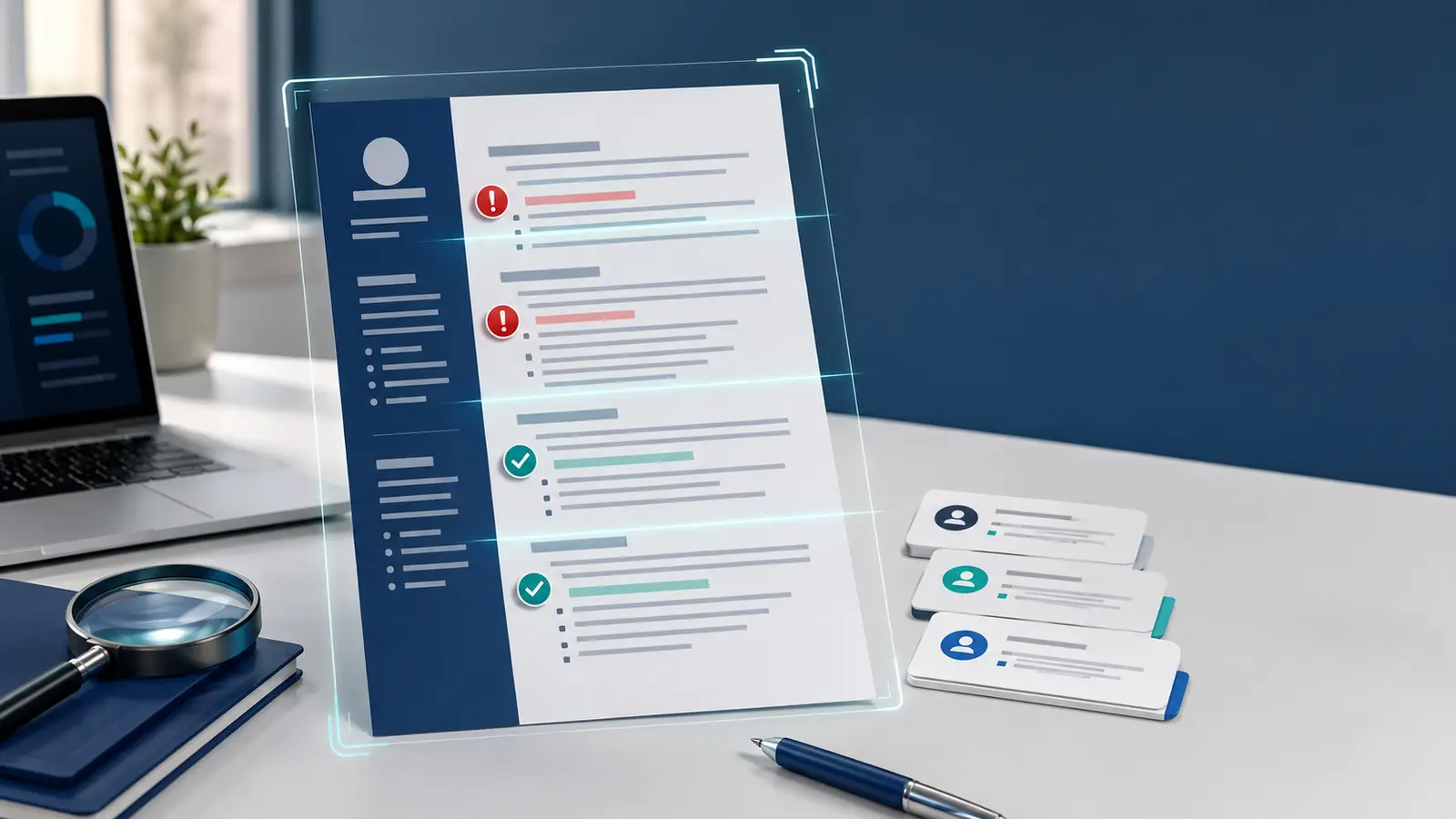
Quick answer: check these seven resume mistakes
- Submitting a file that is difficult to read or extract.
- Hiding essential information inside a complex layout.
- Sending a generic resume that does not reflect the target role.
- Listing skills and duties without evidence.
- Ignoring eligibility rules and application-form questions.
- Using AI-written or inflated claims you cannot defend.
- Creating contradictions across the resume, application and professional profiles.
The ATS and fresher-resume pathway
Use the guide that matches the problem you are solving instead of treating every issue as an “ATS score” problem.
- Understand the systemWhat is ATS?
- Diagnose the matchATS score checker guide
- Correct the gapsImprove ATS alignment
- Fix the fileATS-friendly format
- Build the contentFresher resume format
How resume mistakes cause problems
The portal receives your file and may extract contact, education, skills and employment details.
Application answers, searches, filters or human screening assess whether the profile matches the role.
A recruiter evaluates clarity, evidence, consistency and credibility.
A resume can be strong at one stage and weak at another. A clean file may still target the wrong job. A keyword-rich application may still fail because the bullets provide no evidence. A credible resume can still create problems when the application form contains inconsistent dates or answers.
1Submitting a file the application cannot reliably read
The final resume should work outside the device on which you created it. Open it on another phone or computer, search for your email and one important skill, and copy the text to check whether the reading order remains sensible. This is a rough quality test, not a simulation of every employer’s system.
Five-minute file test
- Follow the job posting’s file-type and size instructions.
- Open the final file on a second device.
- Confirm that the text can be selected and searched.
- Check that dates, bullets and headings remain in the intended order.
- After upload, review any fields populated by the application portal.
For detailed export and parsing checks, use the ATS-friendly resume format for freshers.
2Hiding essential information inside a complex design
A visually designed resume does not automatically fail, and a two-column layout is not universally prohibited. The practical question is whether the final file preserves a logical reading order and whether a recruiter can find the important evidence quickly on a laptop or phone.
3Sending one generic resume for every role
Tailoring does not mean changing facts. It means selecting the most relevant evidence, using accurate terminology from the job description and placing the strongest proof where it is easy to find.
| Job requirement | Weak resume response | Stronger evidence |
|---|---|---|
| SQL and dashboard reporting | Lists “data analysis” in skills | Shows SQL queries, data cleaning and a Power BI dashboard in a project or role |
| REST API development | Lists Java and Spring Boot | Describes endpoints built, database operations and testing performed |
| Campaign reporting | Lists digital marketing tools | Explains the campaign, reporting method and verified result or learning |
| Stakeholder coordination | Claims strong communication | Shows a real presentation, requirement discussion, issue follow-up or team responsibility |
4Listing skills and duties without evidence
A recruiter needs more than the name of a tool. Strong evidence connects an action with a method, scope and outcome. Not every bullet needs a percentage, and fabricated metrics are worse than a clear factual description.
Weak: Responsible for reports and dashboards.
Improved: Prepared weekly Excel reports from operational data and built a Power BI dashboard to compare monthly volume, delays and regional performance.
Weak: Worked on a Java project.
Improved: Built a student-management application using Java, Spring Boot and MySQL with create, update, search and delete functions and tested the primary user flow.
Turn real work into clearer resume bullets
Start with the actual problem, tools, actions and output. Use the generator to organise the writing, then verify every claim.
5Ignoring eligibility and application-form questions
The resume is only one part of an application. Employer-defined questions and required fields can matter as much as the document. A strong keyword match cannot replace a compulsory condition, and inaccurate answers can create problems later.
| Requirement type | What to verify | What not to do |
|---|---|---|
| Education or licence | Exact qualification, specialisation and validity | Do not claim an equivalent credential without evidence |
| Experience | Whether internships or projects count for the stated requirement | Do not convert training into full-time employment |
| Location and shift | Whether you can genuinely meet the condition | Do not select “yes” merely to pass a form |
| Notice period and availability | Your real joining timeline | Do not contradict the dates stated elsewhere |
6Using AI-written claims you cannot verify
AI can help organise notes, shorten repetition and suggest clearer verbs. It should not decide what happened. Start with source material you control: project notes, certificates, job records, portfolio links and real outcomes.
7Creating contradictions across the application
Minor wording differences are normal, but factual contradictions reduce trust. They can also make it harder for a recruiter to understand your timeline or professional direction.
Which mistakes should you fix first?
| Candidate profile | Highest-priority mistakes | Best next guide |
|---|---|---|
| Fresher with no internship | Weak projects, generic objective, unsupported skills | Resume format for freshers in India |
| Fresher using a designed template | Reading order, image-based text, file export | ATS-friendly fresher format |
| Experienced professional | Duty-only bullets, irrelevant older content, weak results | ATS improvement workflow |
| Career switcher | Generic summary, unclear transferable evidence, unsupported target title | Job-specific resume diagnostic |
| Candidate confused by ATS claims | Chasing scores and universal formatting myths | What is ATS? |
A 45-minute resume repair plan
| Time | Task | Output |
|---|---|---|
| 0–5 minutes | Read the complete job description and confirm mandatory requirements. | A realistic apply or do-not-apply decision. |
| 5–12 minutes | Test the final file, contact details and reading order. | A clean application version. |
| 12–20 minutes | Map the most important job requirements to genuine evidence. | A shortlist of resume changes. |
| 20–32 minutes | Rewrite the summary and three to five high-priority bullets. | Clearer role alignment and evidence. |
| 32–38 minutes | Remove unsupported skills, repetition and unnecessary personal information. | A tighter, more credible resume. |
| 38–43 minutes | Compare the revised resume with the same job description. | A diagnostic recheck. |
| 43–45 minutes | Review every populated application field and factual detail. | A consistent final submission. |
Final pre-application checklist
- The job is genuinely suitable.
- The employer’s file instructions are followed.
- The text is selectable and searchable.
- Contact details are current.
- The target role is clear.
- Important skills have evidence.
- Projects describe actions and outputs.
- Experience bullets go beyond duties.
- No metrics or claims were invented.
- Dates and titles are consistent.
- Application answers are truthful.
- The resume was checked against the actual job.
- The final document was reviewed manually.
Diagnose, repair and verify before applying
Use the checker to identify job-specific gaps, then update the resume without inventing skills or experience.
Frequently asked questions
What is the biggest resume mistake?
The biggest mistake is failing to show credible evidence for the target role. Formatting matters, but a perfectly formatted resume still underperforms when the skills, projects and experience do not prove relevance.
Does a high ATS score guarantee an interview?
No. A checker score is a diagnostic estimate based on its own method and the job description supplied. Eligibility, recruiter judgement, competition and business requirements still affect the outcome.
Should every resume be one page?
No universal one-page rule exists. One focused page is often enough for freshers, while candidates with substantial relevant experience may need two. Every page should contain useful evidence.
Are Canva or two-column resumes automatically rejected?
No. The risk depends on the template, exported reading order, selectable text and the employer’s workflow. For important online applications, a simple application version is easier to test and troubleshoot.
Should I add every keyword from the job description?
No. Add terminology only when it accurately describes your skills or experience. Repeating keywords without evidence damages readability and credibility.
Can I use AI to write my resume?
AI can help organise and rewrite verified material. It should not invent tools, achievements, metrics, clients or experience. Review every sentence before using it.
What should a fresher include without work experience?
Use projects, internships, practical coursework, volunteering, certifications and relevant achievements. Explain what you did, which tools you used and what output was produced.
Should I send the same resume for every job?
Keep one accurate master resume, then tailor the emphasis for serious applications. Change the summary, relevant skills and selected evidence without changing the underlying facts.
Browse the Resume Guides for broader writing help and the ATS Guides for application-system and parsing guidance.